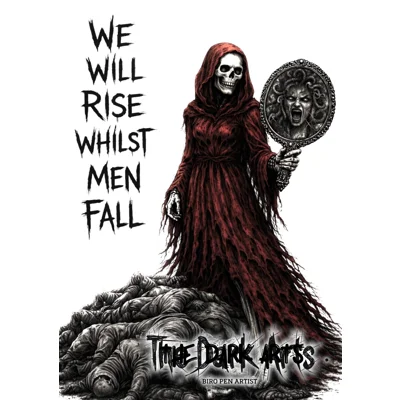
Dark Side Of The Handmaids Tale
This piece was created from a place of anger, reflection, and a deep awareness of how power has been historically taken from women and how, over time, that power is being reclaimed.
I was heavily inspired by the kind of world portrayed in The Handmaid’s Tale, not because it feels distant or fictional, but because elements of it echo realities that have existed and in some ways still exist within society. Systems where women are reduced to roles, where identity is dictated, where autonomy is controlled, and where value is assigned based on obedience rather than individuality.
That idea stayed with me: what happens when a person is stripped down to what others decide they should be?
This piece exists as a response to that question.
The figure stands tall, no longer passive, no longer contained. There is something unsettling about her presence, but that is intentional. Power, especially when it has been suppressed for so long, is rarely soft when it resurfaces. It is raw. It is unapologetic. It can be misunderstood, even feared.
The red garment is a direct reference, but also a transformation. In oppressive systems, it represents control, ownership, and restriction. Here, it becomes something else entirely. It is still heavy, still carries the weight of what it once symbolised, but now it belongs to her. It no longer defines her, it is something she wears on her own terms.
The skeletal face removes identity in one sense, but strengthens it in another. She is not one woman, she is many. She represents generations. Past, present, and future. Those who were silenced, those who resisted, and those who continue to fight for autonomy and recognition.
The mirror is one of the most important elements in this piece. It does not reflect softness, beauty, or anything traditionally expected of women. Instead, it reveals something fierce, something monstrous in the eyes of those who fear it. This is intentional. Society has often framed powerful women as something dangerous, something unnatural. The mirror becomes a confrontation, forcing the viewer to question whether what they are seeing is truly monstrous, or simply unfamiliar power.
Beneath her lies a mass of fallen figures.
This is not about literal violence, it is symbolic of the collapse of systems, ideologies, and structures that have historically placed women beneath men. It represents the dismantling of control, the breaking of hierarchies and the end of unquestioned dominance.
The phrase “we will rise whilst men fall” is not rooted in hatred, it is rooted in imbalance being corrected. It speaks to a shift. A moment where power is no longer one sided. Where voices that were once silenced are no longer ignored.
This piece is not about replacing one form of control with another. It is about reclaiming space, identity, and autonomy. It is about women no longer existing within boundaries they did not choose, no longer shrinking to fit expectations, no longer being defined by roles imposed upon them.
As an artist, I am drawn to themes that challenge societal structures, things that sit beneath the surface but shape how people live, think, and see themselves. This work exists within that space. It is not comfortable, and it is not meant to be. It is meant to provoke thought, to challenge perception, and to question the systems we often accept without reflection.
At its core, this piece is about transformation.
It is about what happens when control is broken, when identity is reclaimed, and when power long denied is finally taken back.
And once it is taken back, it is no longer given away.