Dark Side Of Society
£8.00 inc. tax
This piece was born from a quiet but persistent discomfort, the sense that something about modern life is deeply unnatural, yet so normalized that most people no longer question it.
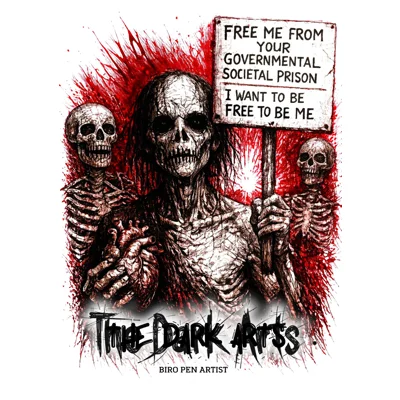
The figure stands at the center as a reflection of all of us, fragile, decaying, and aware on some level that something is wrong. The anatomically correct heart in their hand represents truth, raw, human, unfiltered. It’s not symbolic or romanticized; it’s real, vulnerable, and exposed. It’s what we are at our core before systems shape us.
In contrast, the sign they hold is loud, almost desperate. It reads like a protest, but also like a plea because the figure already looks beyond saving. This tension is intentional. It asks, what happens when awareness comes too late?
The skeletal figures behind them are not just death, they are conformity. They represents the countless individuals who have already surrendered themselves to expectation, routine, and control. They stand silently, almost supportively, as if reinforcing the system rather than resisting it.
The red ink behind them acts as both energy and violence. It can be read as anger, awakening, or the invisible force of control, something that stains everything but is rarely acknowledged directly. It bleeds outward, suggesting that this condition is not isolated but systemic.
At its core, the piece explores the idea that modern society is not just structured but engineered. Rules, expectations, and definitions of “success” are largely shaped by those in power, and the rest of us are conditioned to follow them. From a young age, we are guided into systems that prioritize productivity, consumption, and compliance over individuality and inner truth.
Distractions play a crucial role. Media, entertainment, shopping, food, and digital connections aren’t inherently negative but in excess, they become tools of sedation. They keep us occupied, comfortable enough not to question, and dependent enough not to leave. The result is a quiet trade, freedom for stability, authenticity for acceptance.
The figure’s decayed state suggests what happens over time when a person lives disconnected from their true self. Not physically but spiritually. The soul becomes secondary to the role.
And yet, there is still a faint light in front of them.
That light is ambiguous. It could represent hope, awakening, or simply the illusion of escape. The piece doesn’t answer whether freedom is still possible, it only asks whether we are willing to see the cage we are in.
Ultimately, this artwork
is not just about control, it’s about awareness. Because the most effective systems are not the ones that force obedience, but the ones that make it feel natural.
The figure stands at the center as a reflection of all of us, fragile, decaying, and aware on some level that something is wrong. The anatomically correct heart in their hand represents truth, raw, human, unfiltered. It’s not symbolic or romanticized; it’s real, vulnerable, and exposed. It’s what we are at our core before systems shape us.
In contrast, the sign they hold is loud, almost desperate. It reads like a protest, but also like a plea because the figure already looks beyond saving. This tension is intentional. It asks, what happens when awareness comes too late?
The skeletal figures behind them are not just death, they are conformity. They represents the countless individuals who have already surrendered themselves to expectation, routine, and control. They stand silently, almost supportively, as if reinforcing the system rather than resisting it.
The red ink behind them acts as both energy and violence. It can be read as anger, awakening, or the invisible force of control, something that stains everything but is rarely acknowledged directly. It bleeds outward, suggesting that this condition is not isolated but systemic.
At its core, the piece explores the idea that modern society is not just structured but engineered. Rules, expectations, and definitions of “success” are largely shaped by those in power, and the rest of us are conditioned to follow them. From a young age, we are guided into systems that prioritize productivity, consumption, and compliance over individuality and inner truth.
Distractions play a crucial role. Media, entertainment, shopping, food, and digital connections aren’t inherently negative but in excess, they become tools of sedation. They keep us occupied, comfortable enough not to question, and dependent enough not to leave. The result is a quiet trade, freedom for stability, authenticity for acceptance.
The figure’s decayed state suggests what happens over time when a person lives disconnected from their true self. Not physically but spiritually. The soul becomes secondary to the role.
And yet, there is still a faint light in front of them.
That light is ambiguous. It could represent hope, awakening, or simply the illusion of escape. The piece doesn’t answer whether freedom is still possible, it only asks whether we are willing to see the cage we are in.
Ultimately, this artwork
is not just about control, it’s about awareness. Because the most effective systems are not the ones that force obedience, but the ones that make it feel natural.
Product Code: eNOjneM
Brand: The Dark Arts Art Studio
Product Condition: New

Updating Order Details
Please do not refresh or navigate away from the page!